A single engineer can now have dozens of agents running workflows end to end, and every one of them draws on the same models, tools, and capacity. Multiply that across a company of a thousand people and the number of AI workflows competing for those same resources gets very large, very fast.
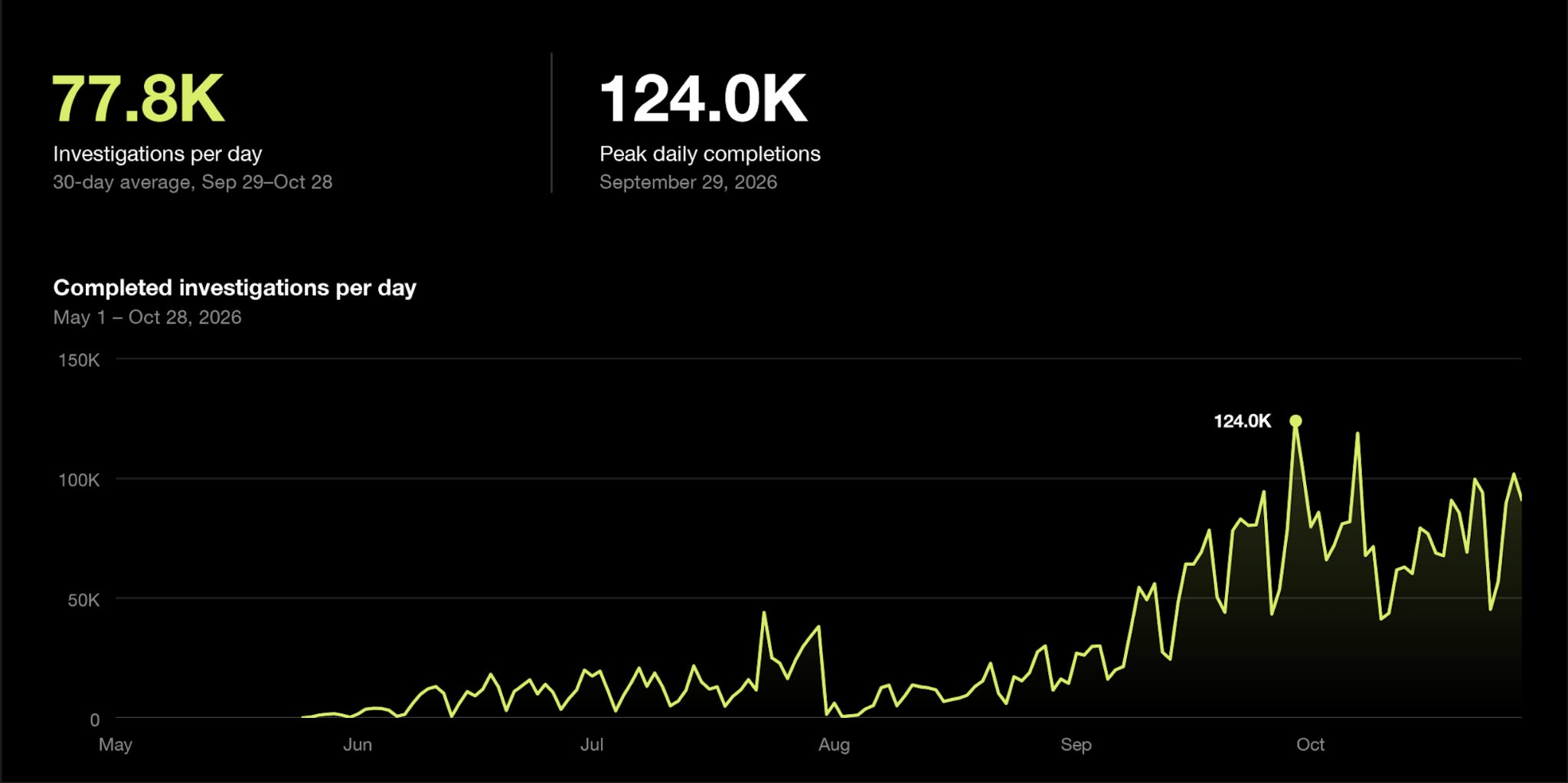
From September 29 to October 28, 2026, our production email classifier workers averaged about 77,800 completed investigations per day.1
Keeping that many workflows from stalling each other, investigating the same email once rather than repeatedly, and giving every team the same tools without each one rebuilding them is a platform problem.2 Here’s how we built one platform that is designed to let all of those agents share models, tools, and capacity without getting in each other’s way.
Giving teams a common foundation
The usual way agents spread through a company is one team at a time, each with its own model client, its own tool wrappers, its own monitoring, and its own idea of what a good evaluation looks like. That works for the first few, but by the time there are a dozen, the same tool exists in five slightly different versions, and, often, an improvement to one never reaches the others.
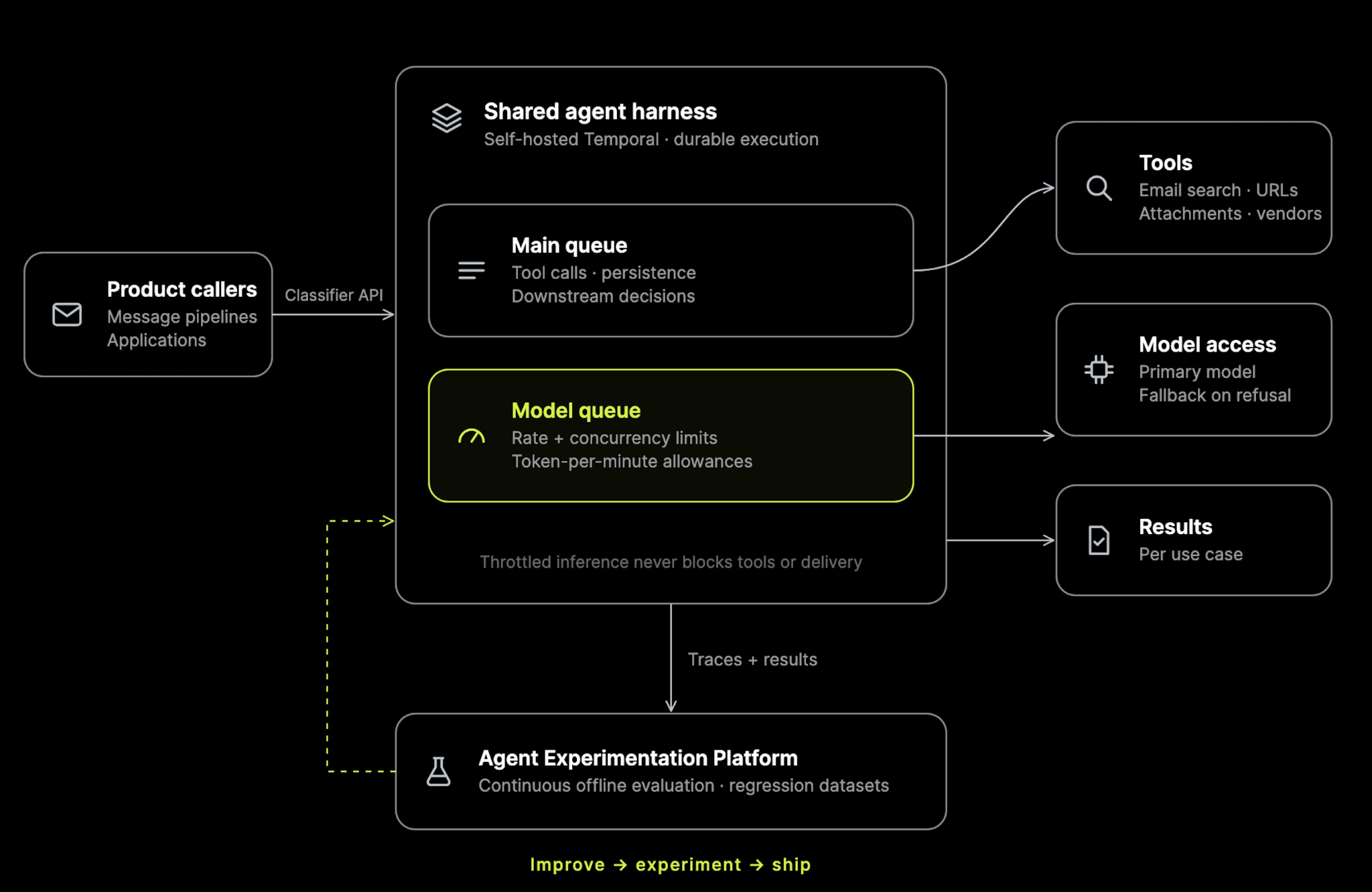
So every agent on our platform runs inside one shared harness, built on self-hosted Temporal, that supplies model access, monitoring, and online and offline evaluation. Teams define the task and the evidence their agent can use, and a shared API starts investigations and delivers results. That single interface is what lets many classifiers owned by different teams run side by side without anyone coordinating deployments.
Democratizing agent building
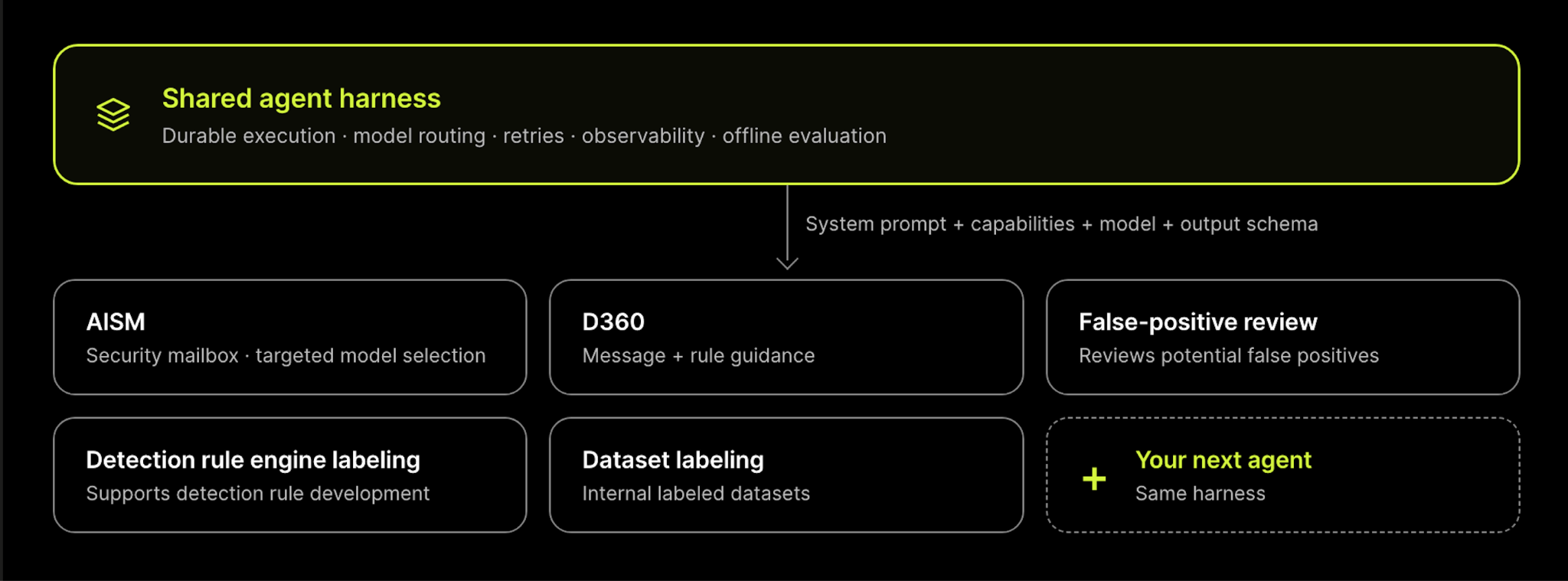
It was tempting to make the agent the thing teams shared, but two agents rarely want exactly the same behavior. What they did want was the same tools and the same context. We made the capability the unit of reuse. A capability gives an agent a tool, relevant context, or guidance for its task, and teams build a new agent by choosing capabilities from a shared catalogue and pairing them with a system prompt.

Because the catalogue is shared, an improvement to one capability reaches every agent that uses it. AI Security Mailbox (AISM), our security-mailbox classifier, combines the shared investigation tools with customer context and skills written for its task, and the other classifiers draw on the same catalogue with different guidance. Loading skills only when a task needs them also keeps each agent’s context focused on its own job instead of everything the platform can do.
Built-in model selection and recovery
The shared harness includes model selection, retry handling, durable execution, and monitoring. Teams configure their models through profiles and include the capabilities, task instructions, and retry policies that their agent needs. The runtime retries transient model failures and preserves the investigation. If a model keeps failing, the profile’s fallback models continue the investigation.
Investigate once, deliver every result
One email can arrive for many recipients. Each needs a result, but the investigation only needs to happen once.
The platform deduplicates investigations already in progress. When copies of the same email are investigated for the same use case within a customer’s tenant, their requests join the existing run and await its result. The platform also reuses completed investigations, while preserving recipient-specific processing.2
From August 30 to October 28, 2026, production workers recorded approximately 1.04 million duplicate start attempts that reused completed results.3 That freed execution capacity for new investigations.
Keep inference from blocking everything else
LLM inference is the throughput bottleneck. Adding workers alone cannot overcome an upstream model’s rate limits. If model requests share execution limits with other work, waiting for inference can also delay tools and downstream decisions. We give model requests a separate, enforceable capacity from tool execution and result delivery, so throttled inference never blocks those stages.
What changed in production
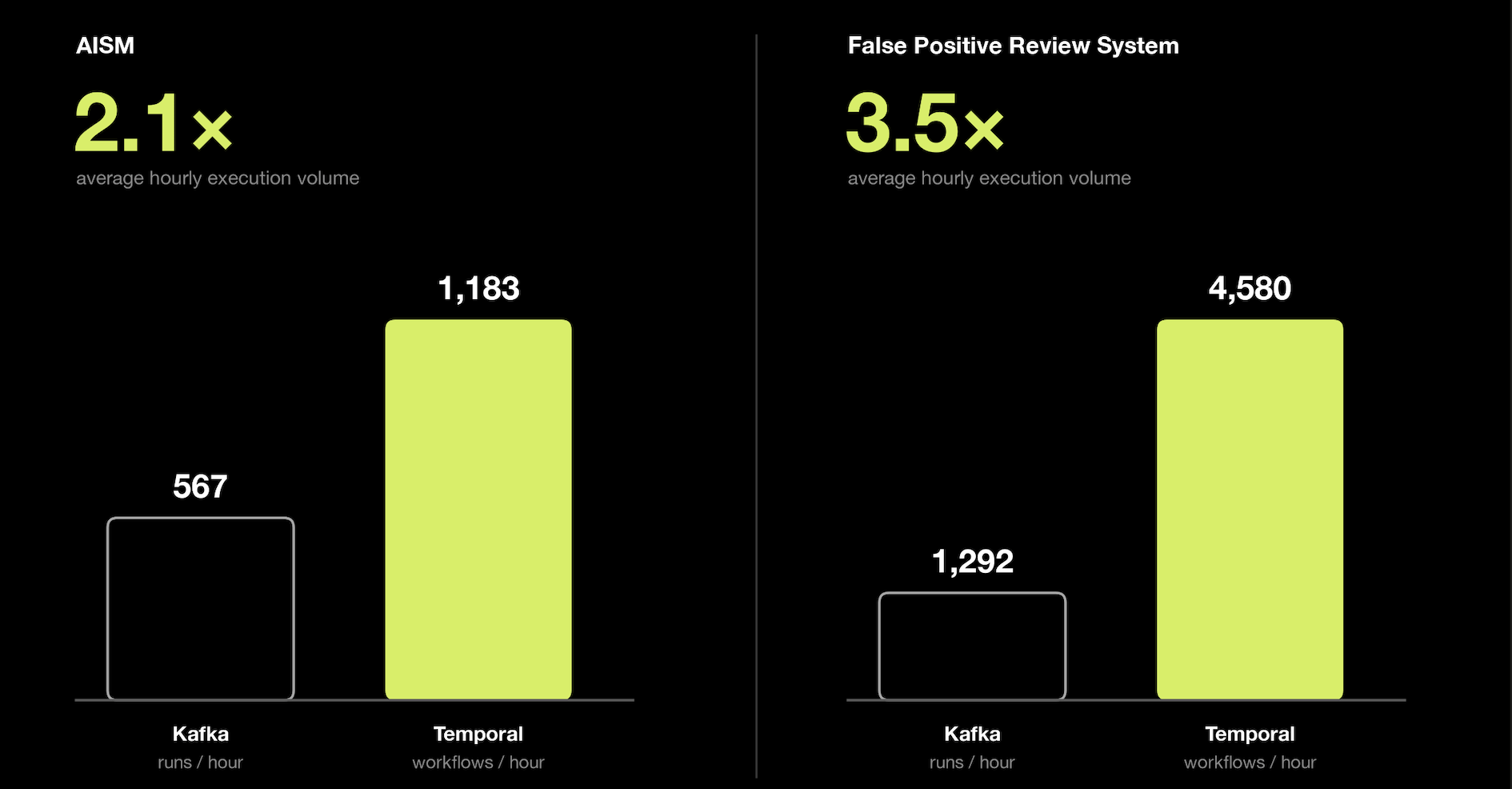
Average hourly execution volume was 2.1× the legacy Kafka rate for AISM and 3.5× for our pipeline for reviewing potential false positives. Figure 4 compares Kafka runs with Temporal workflows. These multiples compare execution volume, not efficiency or cost.4
Classification quality provides a separate measure of progress. Our detection-rule development system reduced false attack labels by 90% in a human-reviewed set of messages on which it disagreed with the legacy labeler. These were safe emails incorrectly classified as attacks. Attack recall on the same set remained similar.5
Our False Positive Review Agent System reported approximately 360,000 labels from September 28 to October 4, 2026.6 An evaluation of 990 messages from that period reported that 92 of 95 decisions in its confident-safe subset agreed with AISM, our security-mailbox reference agent: 96.8%.7 This measures consistency with AISM, not accuracy against confirmed outcomes.
Shipping feeds the next experiment
Our Agent Experimentation Platform connects production experience to the next improvement: improve → experiment → ship.
Teams evaluate changes to prompts, capabilities, and models for classification quality, latency, and regressions. Promising changes can run on live traffic in a mode designed to avoid changes to decisions before rollout.
Production agent traces and results feed continuous offline evaluation where failures become test cases that guide the next experiment.
What comes next
The platform is expanding into longer, more complex work. We are developing a machine-learning engineering loop in which an agent can investigate model failures, propose changes, launch training experiments, and evaluate the results. We are also developing rule-writing workflows that draft detection logic and test it against evidence. These are designed to run for hours, wait on outside jobs, and change course midway.
The platform gives teams a common foundation for building and operating agents. Teams can reliably build, ship, and govern agents through shared infrastructure. Evaluation findings guide the next experiment. We are extending this foundation to support longer investigations and new use cases.
If this is how you want to work, we’re hiring!
Subscribe to Abnormal’s Builder Substack to see how we actually build with AI, with real stories from our engineering and product teams: