



Abnormal AI stops the cyberattacks that legacy tools miss. If your company still treats AI like a pilot program, you’re in the wrong place. AI-powered engineering is our default, and we’re hiring.
In our last post, I explained why we view our Go-to-Market systems as a product engineering problem and the unique bets we took as an AI-native development team.
A lot of people asked the natural follow-up question…
Okay, but what is the team actually building?
After several months of shipping localized projects across sales, marketing, and operations, we’ve found that the work clusters around three problems that look different on the surface but share structural similarities underneath.
Sales and Customer Success: How do we make every customer-facing rep twice as effective (in pipeline, win rates, deal times, etc)?
Marketing Experiences: How can we spend less to generate more pipeline and deliver more delightful customer experiences?
Operational Upleveling: How do we keep health scores, prospect lists, and POV forecasts accurate and precise, so they can be leveraged to make more agile and detailed optimizations of our GTM engine?
These problem spaces are listed in order of maturity. Sales and Customer Success is the most refined, and Operations is the newest bet. Working backwards from those objectives helps us develop a framework for each; something where we’re confident that progression along various dimensions will be sufficient to realize those objectives.
As a disclaimer, while many of these projects are still in their development and pilot stages, we publicly share our work in progress and specific demos are linked below.
Sales and Customer Success
I shared some completed projects in our previous post, so I’ll focus on our next set of ambitions in this one.
The key insight we discovered about this problem space is that many customer-facing personas: sales development representatives (SDRs), account executives (AEs), sales engineers (SEs), and customer success managers (CSMs), are wrestling with structurally similar problems. They just take inputs from different data sources and have different nuances depending on their stage in the customer journey.
On one dimension, we have the customer journey: from pipeline generation (SDRs and AEs reaching out to prospective customers to qualify them and create opportunities to win their business), to active opportunities (AEs and SEs proving the value of Abnormal in pilots to win contracts), and customer success (CSMs and AEs working to ensure satisfied customers are continuously getting more value out of our platform).
Across those stages, every function faces similar day to day problems: what accounts to prioritize to get the biggest bang for their effort, determining a concrete plan to advance progress, timely follow ups after engagements, and continuous administrative work; leaders also need to plan and enable their team for growth.
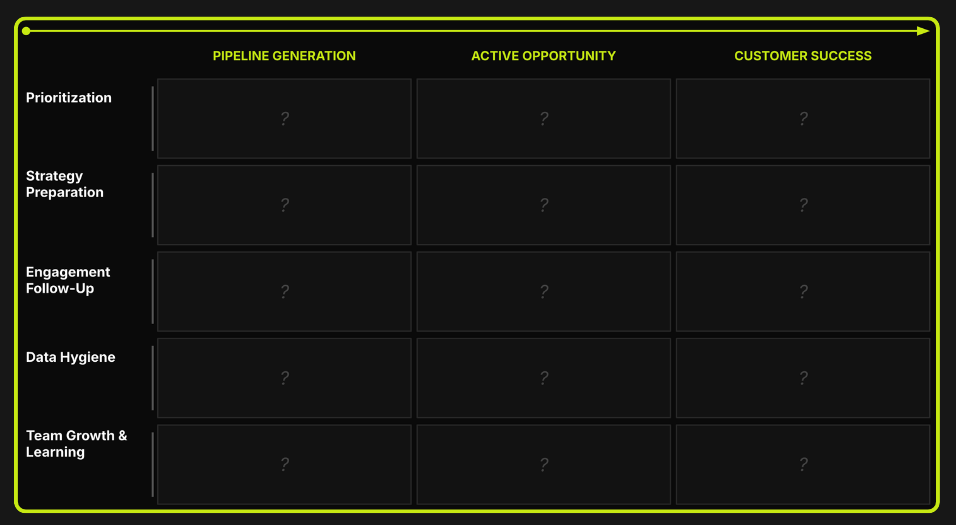
What makes this more than a collection of individual automations is how the cells can connect into a unified experience.
Take an end-to-end Customer Success example workflow:
Each Week, Customer Health Scoring: An AI agent sweeps through all paying customer accounts, pulling from Gong call transcripts, email engagement, support ticket volume, product usage trends, renewal timelines, etc, in order to produce a prioritized list of accounts to tackle, with auditable explanations.
For Each Critical Account, AI Drafted Action Plans: The system then uses those conclusions to draft a concrete action plan for at-risk accounts or expansion opportunities.
For Each Action Plan, AI Initiated Preparation Materials: The plan might surface a recommendation to schedule an executive touchpoint and assign a sponsor. When that meeting lands on the executive’s calendar, the system automatically delivers a brief with account history, recent risk signals, and suggested talking points. The executive walks in prepared; no coordination toil required.
After Plan Execution, Follow-up Automation and CRM Updates: After a successful engagement, the AI steps in to process the latest transcript and activity, ensuring unanswered questions get drafted for the CSM and Salesforce objects are updated to reflect what happened.
The first scenario encompasses prioritization, the second and third cover strategy preparation, while the fourth touches on engagement follow-up and data hygiene.
While you could locally optimize each step with an AI assistant or low-code automation (the “10% better” solution), we believe that truly step function productivity changes can only come from building an autonomous system, like the one described, accompanied by reimagined user-agent process changes.
Marketing Experiences
Compared to sales and customer success, we don’t have a concrete puzzle for marketing yet. But working across several early projects has surfaced a few principles and shared elements that shape our direction:
Encode taste into the system. The obvious risk with AI-generated output is slop: generic copy, off-brand visuals, etc. As a result we work with subject matter experts to encode brand voice and design principles (some call this “taste”) into structured files that every agent works from. When an expert marketer wants to change messaging emphasis, they can update the guidance docs and see changes reflected through all the outputs.
Turn human assembly lines into human system architects. Many marketing workflows today are assembly lines: a sequence of specialists project-managed through handoffs, each waiting on the last. We replace those sequences with coordinated AI agents and transition people from cogs in the process to architects of the system itself. This enables Abnormal to respond with more agility to external trends and generate more content at consistent quality.
Build feedback loops to accelerate data governance. Every AI-generated customer touchpoint is a potential point of factual inaccuracy or messaging misalignment. As such, we implement common guardrails so all public-facing experiences consume vetted content with tight messaging. Human review of AI drafts feeds back into prompt improvements that will raise quality over time, analogous to our feedback loops for design docs.
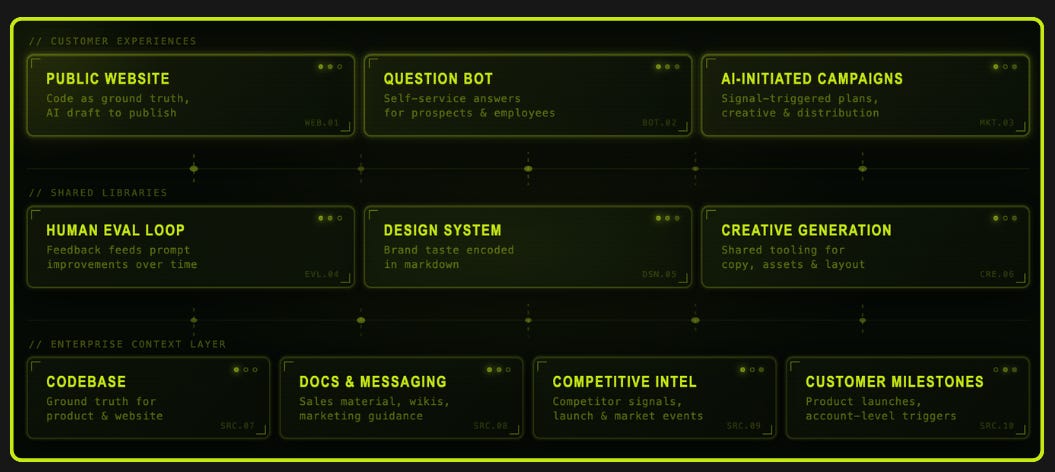
AI-Generated Webpages (see more)
Shipping a product update to the website takes weeks today, with creative, copy, design, and legal queuing up in sequence.
We encoded those teams’ expertise into best-practice files that Claude works from, so updates flow from code as ground truth through an AI draft, to human review and feedback, without anyone maintaining content continuously. When marketing wants to change objectives, messaging emphasis, or structural priorities, they can update the marketing guidance docs and see the changes cascade through the site automatically before it gets published.
The result isn’t just faster updates to existing pages, but also richer content and greater personalization that was previously not economically viable to maintain: interactive feature-level deep dive elements, company-level personalized solutions, etc.
Abnormal Question Bot (see more)
Product questions today often come from live calls or emails and get routed through reps or support queues into a litany of Slack threads, email chains, or JIRA tickets; all slow in response, inconsistent in messaging, and time consuming for internal functions.
To create a help site, we started developing a shared enterprise context layer backed by code and trusted non-code data sources alongside messaging documents and sales material. Every question that Claude Code can’t answer and is deflected to a human will also be routed to a data governance agent that drafts new content in the context layer for verification, gradually closing the last-mile gaps over time.
Not only does this help employees get fast consistent responses to a range of questions, it also enables prospects and customers to self-service their own inquiries.
AI-Initiated Digital Campaigns
Digital campaign production today is serial: brief → creative → copy → approval → launch. Our goal is a pipeline where AI monitors signals (competitor announcements, product launches, customer milestones) and generates campaign plans, creative, copy, and distribution automatically.
We think about maturity along both vertical depth (how high up the marketing abstraction the agent operates) and horizontal breadth (how many digital channels the agent can control with minimal supervision). The goal is to “climb the diagonal” across both dimensions over time.
Operational Upleveling
Every project above generates data. Operations is where we mine it to uncover optimizations that feed back into higher quality work. It starts with cleaning our systems of record so demand generation activity measurably connects to our sales engine.
One early application of this collected data is our automated loss analysis pipeline (see more).
Every time an opportunity moves to closed-lost, an agent researches every associated deal artifact (Gong transcripts, email activity, created artifacts, etc), and produces a structured loss report.
A second agent queries the corpus of pre-processed reports for aggregate patterns and quantified statistics: which competitors appear the most in EMEA, which product gaps correlate with mid-market losses, which deal stages are leaking, etc.
The same approach can extend to win analysis and feed into downstream systems like AI-predicted forecasting, renewal churn prediction, etc.
We’re still in the early days…
These three themes look different on the surface.
But underneath, they all run on the same trigger-agent-action pattern, share the same data connectors and output tools, and compound; every project makes the next one faster to ship and easier to maintain.
The shared infrastructure keeps growing, and every new building block that we factor out becomes an accelerant of future projects.
And while everything above is actively being built, this is just the tip of the iceberg in terms of our ambitions.
If you read this and started mentally imagining yourself building out one of these projects, or think we’re missing something important in the puzzle, we’d love to talk.
love it mickey!